
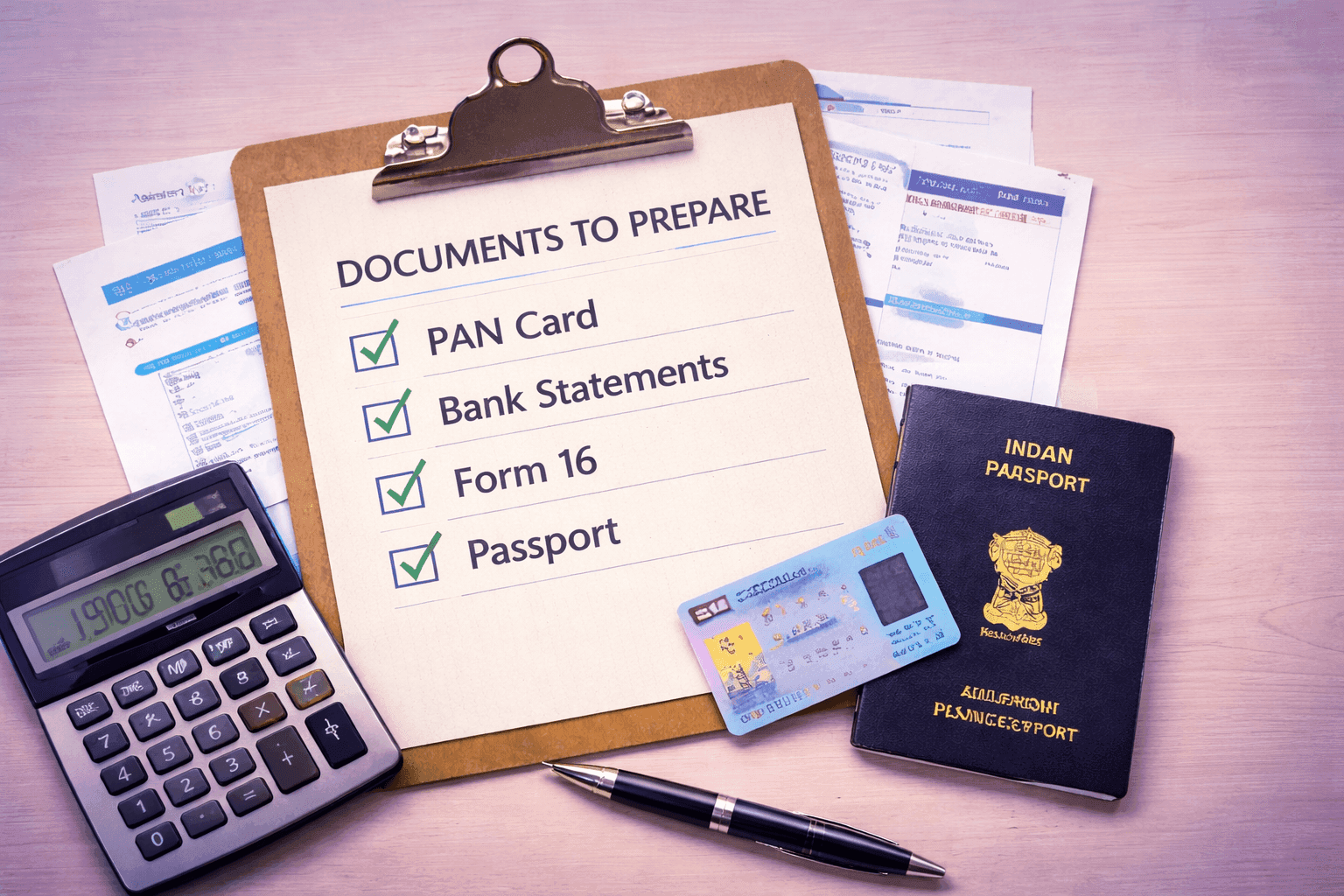
Filing your Indian tax return as an NRI involves documents from multiple countries and institutions. Getting them ready early saves time, avoids errors, and reduces the chance of a tax notice.
1. Personal & Identity Documents
- PAN card
- Passport with travel stamps
- Record of your entry and exit dates from India
- Proof of Indian address (if you have one)
2. Income Documents
If you earn a salary in India:
- Form 16 from your employer
- Salary slips
If you earn rental income from Indian property:
- Rent receipts, lease agreement, property tax bills
If you have foreign income:
- Payslips in foreign currency
- Employer tax deduction statements
If you have investment income:
- Dividend statements, interest certificates, broker statements
3. Tax Documents
- Form 26AS - Shows all tax deducted on your behalf (download from NSDL)
- AIS - A summary of all your financial transactions reported to the tax department
- Form 16 - TDS certificate from your Indian employer
- Foreign Tax Certificate - Proof of taxes paid abroad (helps avoid being taxed twice)
- Tax Residency Certificate (TRC) - Confirms you are a tax resident of another country
- Tax payment challans - If you paid advance or self-assessment tax during the year
4. Property & Asset Documents
- Property deeds and purchase agreements
- Property tax notices
- Loan statements showing interest paid
- Insurance policy documents
- Broker or trading statements
5. Deduction Documents
| Section | What to Collect |
|---|---|
| 80C | LIC premiums, PPF, ELSS, home loan principal, FD receipts |
| 80D | Health insurance premium receipts |
| 80G | Donation receipts from registered charities |
6. A Common Misconception: Schedule FA and FSI
Many NRIs are incorrectly advised to fill Schedule FA (Foreign Assets) and Schedule FSI (Foreign Source Income). These schedules are not required for NRIs. They apply only to Resident Indians who hold foreign assets or earn foreign income abroad.
Filling these schedules unnecessarily as an NRI can create avoidable compliance issues.
The only exception is if your income is taxable in both India and your country of residence and you are claiming relief under a Double Taxation Avoidance Agreement (DTAA) - in that specific case, Schedule FSI and Schedule TR may be applicable. If this applies to you, consult a qualified tax professional.
7. How to Stay Organised
- Keep one folder per financial year
- Sub-folders: Income / Deductions / Assets / Tax Proofs
- Name files with dates: e.g., Salary_Apr2024.pdf
- Scan originals and back them up on the cloud
8. When to File
| By When | What to Do |
|---|---|
| June | Start collecting documents |
| Early July | Review with a tax professional |
| 31 July | File your return |
| After filing | Keep all records for at least 6 years |
9. Quick Tips
- Always confirm your residency status first - it affects everything else in your return
- Cross-check Form 26AS and AIS against your actual bank and broker records - do not assume they are correct
- Keep a note explaining any mismatches between your records and the tax department data
- After filing, save your final computation, all supporting documents, and your ITR acknowledgement together in one place