
NRI tax returns are reviewed more closely than resident returns. The income structure, residency proof requirements, and foreign tax claims are more complex - and a single error can trigger a notice that delays your refund by months.
Here are the four mistakes we see most often, and how to avoid them.
Error 1: Wrong Residency Classification
The mistake: Filing as "Resident" when you should be "Non-Resident," or vice versa. This one error changes everything - what income is taxable, which schedules apply, and what exemptions you can claim.
The impact: If wrongly classified as Non-Resident, you may under-declare income. If wrongly classified as Resident, you may pay tax on foreign income that should be exempt.
How to avoid it: Count your days in India using actual calendar days before filing. If you are close to the 182-day threshold, document every day with passport stamps or boarding passes. Confirm your status before proceeding.
Error 2: Mismatch Between Form 26AS and Declared Income
The mistake: The TDS reflected in Form 26AS or AIS does not match the income declared in your return. Even a small discrepancy immediately flags your return for scrutiny.
The impact: The tax officer assumes underreporting or inflated deductions and issues a notice requesting reconciliation. Even if you are ultimately correct, you lose time and create unnecessary stress.
How to avoid it: Download Form 26AS and AIS in June. Reconcile every TDS entry against your salary slips, bank deposits, and employer records. If Form 26AS is incorrect, ask your employer to file a TDS correction with the Income Tax Department before you submit your return.
Error 3: Incomplete Business or Profession Details
The mistake: You run a consulting practice abroad or in India as an NRI but file a return without proper income and expense details.
The impact: The tax officer may treat this as underreported business income and apply penalty provisions or rough estimates. If an audit is initiated years later, missing documentation becomes a serious problem.
How to avoid it: Maintain complete business records - client invoices, expense receipts, and bank statements. File Schedule BO with a full profit and loss account and balance sheet. If your gross turnover from business exceeds ₹1 crore, or gross receipts from a profession exceed ₹50 lakhs, a tax audit under Section 44AB is mandatory and must be completed by a Chartered Accountant before you file your return. Retain all business and professional records for the applicable retention period.
Error 4: Not Preserving Documents After Filing
The mistake: Filing the return and assuming the job is done. Many NRIs do not retain their documents, working files, or computation notes after submission.
The impact: If the Income Tax Department raises a query, asks for a rectification, or initiates scrutiny, you have no trail to support your return. Responding without documentation is extremely difficult.
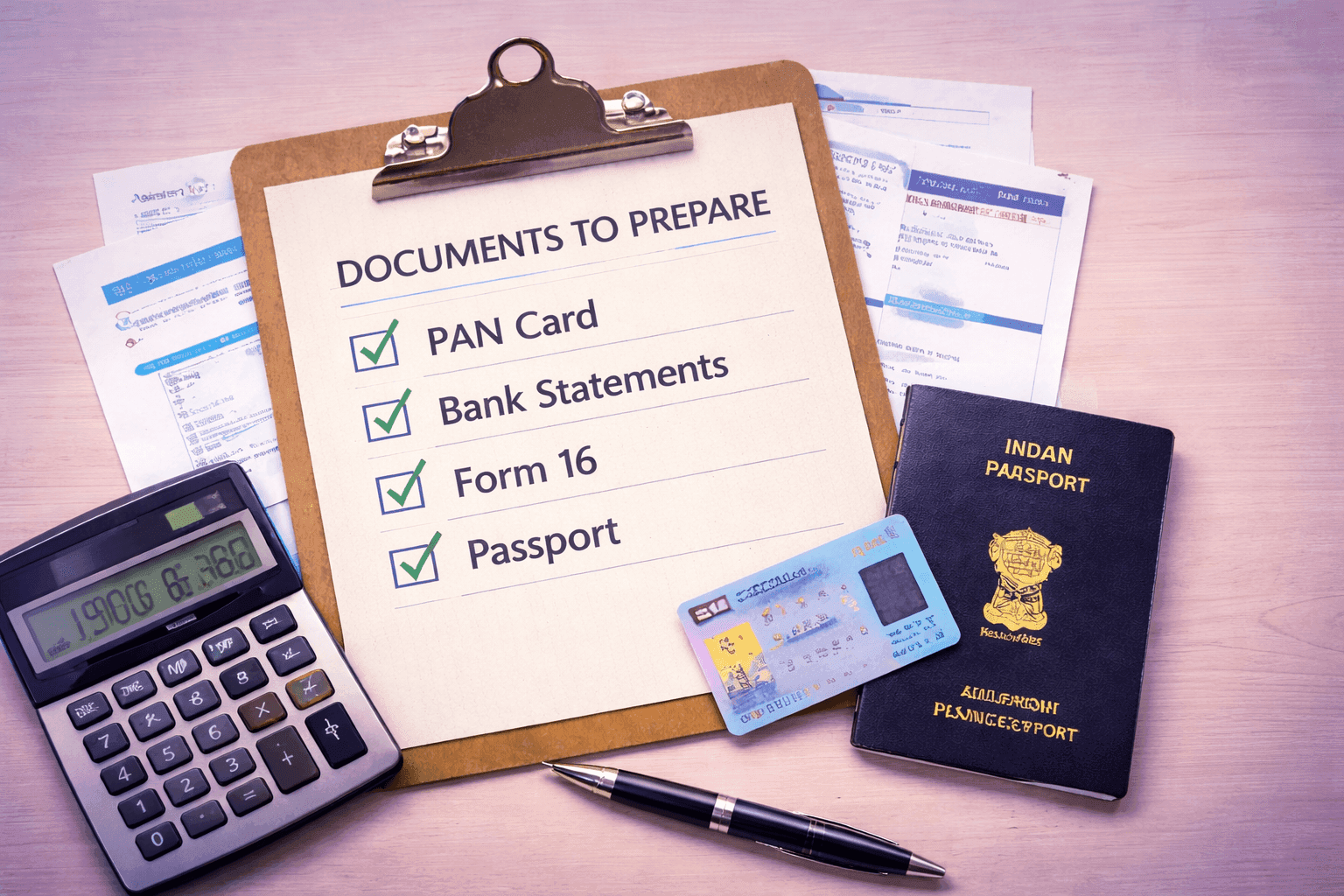
How to avoid it: After filing, ensure the following documents are saved together in a clearly labelled folder for the relevant financial year:
- ITR acknowledgement (ITR-V)
- Final tax computation workings
- All income and deduction proofs
- Bank statements and broker records used for the return
- Any correspondence with your tax advisor
Final Checklist Before You File
| Item | Done? |
|---|---|
| Residency status confirmed with day-count calculation | □ |
| Form 26AS and AIS downloaded and reconciled with records | □ |
| All Indian income correctly declared under the right heads | □ |
| Schedule BO filed with complete P&L if business income exists | □ |
| Tax audit completed by CA before filing if applicable | □ |
| Correct bank account updated for refund credit | □ |
| All documents archived in a dated folder post-filing | □ |